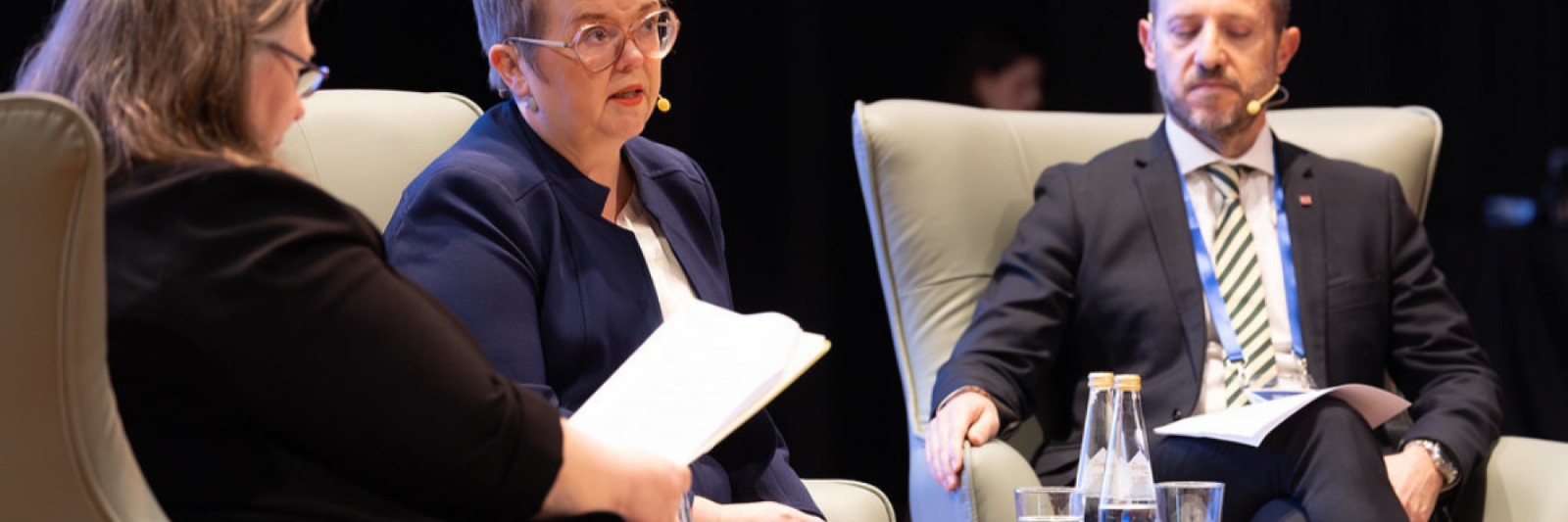
On 17 April 2026, Aurora was represented at the European University Association (EUA) Annual Conference in Istanbul, where Rector Silja Bára R. Ómarsdóttir of the University of Iceland spoke in a plenary session on the future of international cooperation in higher education. The discussion brought together university leaders to reflect on how alliances contribute to long‑
term collaboration and institutional transformation.
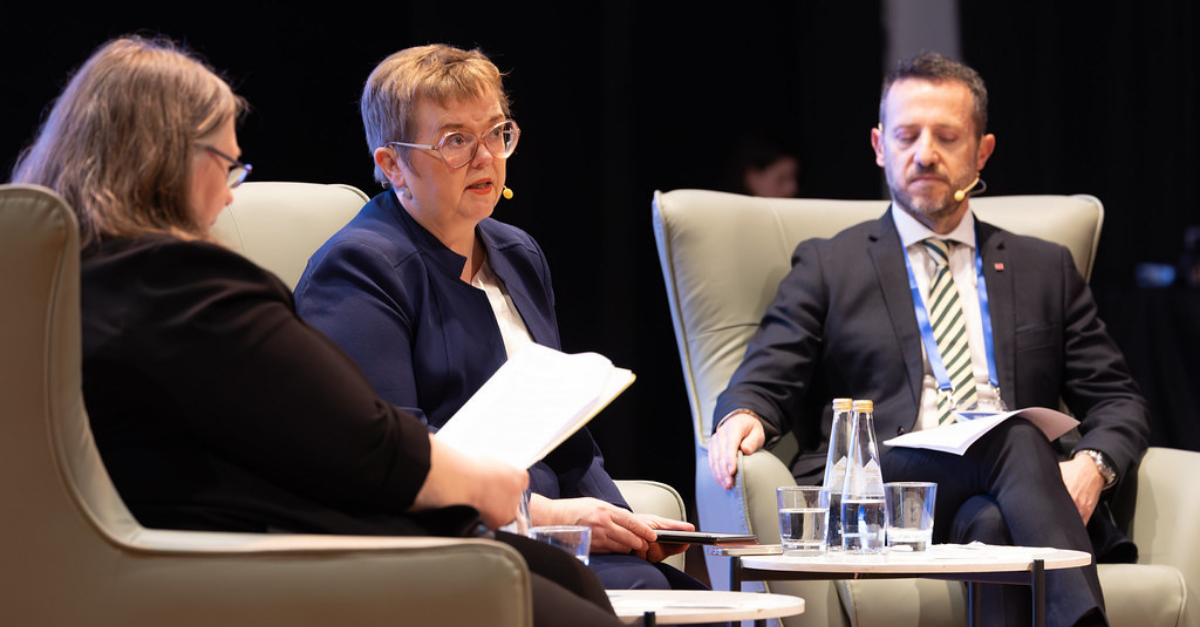 From left to right: Amanda Crowfoot (European University Association), Silja Bára R. Ómarsdóttir (University of Iceland), and Pedro Azeres (University of Minho)
Deepening International Cooperation Through Aurora
Rector Ómarsdóttir drew on the
University of Iceland (UI)’s long-standing involvement in Aurora to show how the alliance has evolved over time. She highlighted the shift from Aurora’s beginnings as a high‑trust network in 2016 to its role as a European university alliance from 2020 onwards. This development has strengthened cooperation across partner universities and expanded opportunities for students and staff.
“The value created by Aurora is moving beyond traditional student and staff exchange programmes toward deep, high‑trust internationalisation of education and research,” said Rector Ómarsdóttir. “Through our participation in Aurora, we prioritise institutional transformation that embeds internationalisation into our core structures rather than treating it as an add‑on.”
She noted that Aurora has increased access to transdisciplinary courses, and supported staff development and research cooperation. For UI, this has translated into a multiplication of student interest and participation in short-term mobility, while providing staff with robust frameworks for pedagogical development and research collaboration. This approach positions Aurora as a space where universities can test new ideas, streamline processes, and work collectively towards a more connected European academic landscape.
Leadership and Institutional Alignment
A key theme of the session was the role of leadership in ensuring that alliance engagement is firmly embedded within universities. Rector Ómarsdóttir explained how her university integrates Aurora into its governance structures. As Rector, she sits on the
Aurora Board and General Council, providing strategic direction along with other Aurora universities’ presidents and rectors. Furthermore, two Vice-rectors participate in the respective Vice-rector bodies for Education and Research, ensuring that alliance initiatives are directly integrated into UI’s core academic mission.
A primary goal for UI is also to embed the Aurora mission more deeply into the university’s new institutional strategy. The university’s participation in Aurora is a central pillar of its identity and internationalisation priorities.
She also addressed the challenges created by national regulatory and funding frameworks. In Iceland, universities involved in European alliances have joined forces to advocate for more supportive conditions for internationalisation. By collaborating on high-level discussions with the Ministry of Higher Education, they have successfully highlighted the friction between their international ambitions and the current financial model. This coordinated approach has contributed to constructive dialogue with national authorities.
Alliances as Platforms for Future‑Oriented Cooperation
The plenary explored whether alliances are becoming a central model for international cooperation or one tool among many. As a laboratory of change, Aurora’s experience shows how alliances can act as platforms for experimentation, balancing deep integration with wider global engagement.
“I see great advantages in European degrees and access to micro-credentials that students can bring back into their study programmes at home,” said Rector Ómarsdóttir. “We cannot offer all the specialisations that we know our students want to get access to. Short term exchanges and international courses open the doors to more diverse study programmes and expand our students’ horizons, and those of our staff as well!”
Rector Ómarsdóttir emphasised that sustaining this level of cooperation requires trust, shared purpose, and long‑term commitment — all essential for building resilient partnerships across Europe.