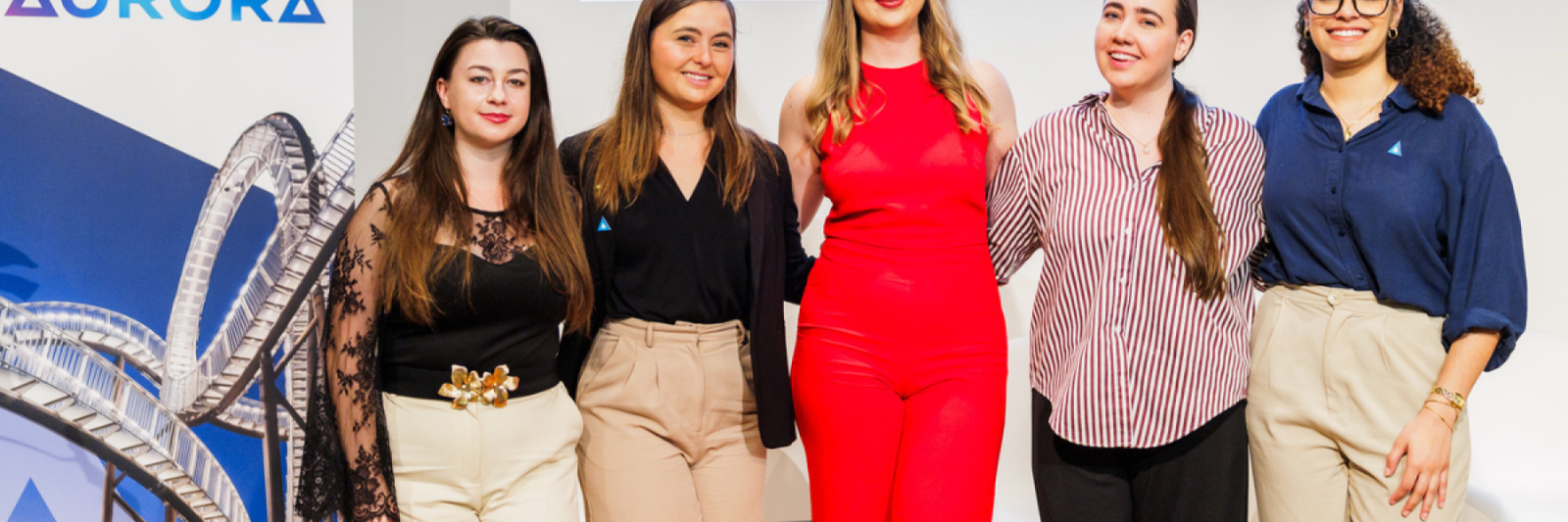
Student participation within Aurora is shaped by both formal governance structures and collaborative learning practices. At the Aurora Annual Conference 2026 hosted by the University of Duisburg-Essen (UDE), the plenary session “Window into Student Representation” and the Peer-to-Peer Learning Workshop explored how students contribute to governance, collaboration and community building across the alliance.
 From left to right: Eliška Karasová, Emelie Schultz, Simona Gibalová, Alma Ágústsdóttir, and Erin Gourves. © Photo credit: eventfotograf.in
Student Voice In European Governance Frameworks
The plenary session at the
Aurora Annual Conference 2026 brought together members of the
Aurora Student Council (ASC), including ASC President Simona Gibalová (Pavol Jozef Šafárik University in Košice), ASC Vice-president Eliška Karasová (Palacký University Olomouc), ASC member Emelie Schultz (Copenhagen Business School), and former ASC President Alma Ágústsdóttir (University of Iceland). The session was moderated by ASC member Erin Gourves (Université Paris-Est Créteil).
The panel highlighted developments in student governance within Aurora, including work on the Aurora Students’ Rights Charter as a shared framework across student cohorts, and the integration of Aurora student representation into broader European structures, particularly through the
European Students’ Union (ESU).
Speakers also discussed inter-alliance collaborations like
FOREU4ALL, which brings together European university alliances to exchange on democratic student representation and the accessibility of student mobility. Panelists touched upon the
European Student Assembly (ESA), a gathering of student representatives from various European alliances working on codes of conduct and governance frameworks to improve transparency.
These initiatives reflect the gradual embedding of student voice within European-level governance structures, moving towards more formalised and sustained engagement.
Simona Gibalová, President of the Aurora Student Council, emphasised the importance of strengthening students’ role within Aurora’s governance structures. “For me, the most important priority for strengthening student participation within Aurora is the active and systematic inclusion of students in decision-making and governance structures. At the same time, it is essential to foster students’ intrinsic motivation to engage in shaping the future of higher education.”
The session highlighted ongoing challenges such as onboarding processes, local coordination, the need for dedicated staff for student engagement, and the importance of recognising student engagement through formal mechanisms such as certification. To address these challenges, the ASC introduced a new role on its Board to support continuity between cohorts and guide new members more effectively.
Erin Gourves, ASC member underlined the dual nature of effective student participation. “Students play a meaningful role in international cooperation and in strengthening inter-university relationships. Effective student representation relies on two complementary elements: student engagement itself, and institutional support for student-led initiatives.”
Peer Learning And Collaborative Exchange
Aurora Student Ambassadors and ASC members met on the final day of the conference to exchange practices across institutions, with a particular focus on onboarding processes and strengthening collaboration between universities within the alliance.
Undertaken with the
Aurora 2030 T7.2 Development of Aurora Student Community, the Peer-to-Peer Learning Workshop explored peer learning as a collaborative practice based on discussion, mentoring and reciprocal teaching.
Students identified a range of effective tools and formats, including Menti, Kahoot, post-it exercises, Miro boards and structured feedback sessions, while noting that unmoderated breakout rooms tend to limit participation and reduce interaction.
Peer-to-peer learning workshop on onboarding processes and best practices across Aurora universities.
From Institutional Structures To Collaborative Student Communities
Both sessions converged on a shared observation: student engagement within Aurora is increasingly shifting from formal governance roles towards more co-creative and networked forms of participation and community building.
Rather than being confined to institutional frameworks, students are actively contributing through peer learning, inter-university collaboration and informal exchanges that strengthen collective identity across the alliance.
Strengthening support mechanisms, ensuring continuity and enabling sustained cooperation will therefore be essential in consolidating this ongoing development within Aurora.