A New Seminar Series on Open Science, Citizen Science and Transferability, from the Aurora Science and Society Team Launches
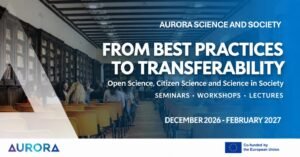
The Aurora Science and Society Task Team is launching a new series of online workshops and seminars, From Best Practices to Transferability: Open Science, Citizen Science and Science in Society, running from December 2026 to February 2027. Building on the success of the previous cycle, the initiative aims to explore how Open Science, Citizen Science and societal engagement can be translated into sustainable research practices and adapted to different institutional, disciplinary and societal contexts. Organised within Aurora 2030 Task Team 10.2 “Science in Society”, the series draws on the results of the Aurora Inventory of Best Practices and Tools for Science in Society (D10.2). Primarily addressed to doctoral candidates across Aurora universities, the events are also open to Master’s students, early-career researchers, and academic and professional staff.
From Principles to Practices — and Towards Transferability
The new series follows the first cycle, Open Science and Citizen Science: From Principles to Practices (November 2025 – May 2026), which introduced participants to key aspects of Open Science and Citizen Science, including research data management, FAIR principles, open-source workflows, Open Access publishing, ethics and artificial intelligence.
With seven events, more than 420 registrations, approximately 390 attendances across sessions and 215 certificates of attendance, the first cycle demonstrated a strong interest in developing more open, collaborative and socially engaged approaches to research.
The 2026-2027 series takes this work a step further by addressing a central question: what makes a good practice transferable across institutions, disciplines and societal contexts?
Drawing on concrete experiences and complementary perspectives, the sessions will explore how research practices can be shared, adapted and further developed, strengthening collaboration between researchers, institutions and society.
Connecting Research and Society Across Aurora
The programme brings together speakers from Aurora universities and other institutions to discuss the practical and conceptual dimensions of Open Science, Citizen Science and societal engagement.
Each two-hour online session will combine the presentation of concrete experiences with broader methodological and theoretical perspectives, leaving substantial time for discussion and exchange.
Topics include co-creation and civic co-design, Science Shops and participatory research, public health and community engagement, marine biodiversity, FAIR data and reusable evidence, patient involvement, and biodiversity monitoring.
By addressing themes connected to all five Aurora Hubs, the series highlights how open and participatory research can contribute to collaboration across disciplines and strengthen the societal relevance of scientific knowledge.
Opening Workshop: From the Aurora Inventory to Practice
The series will begin on 11 December 2026, from 15:00 to 17:00 CET, with an online opening workshop entitled From the Aurora Inventory to Practice: Open Science, Citizen Science and Science in Society.
The workshop will introduce the main results of Task Team 10.2 and the Aurora Inventory of Best Practices and Tools for Science in Society, presenting the six analytical dimensions underlying the inventory: openness, participation, FAIRness and reuse, education and capacity building, societal relevance, and transferability.
The opening session will feature two contributions:
- Roberto Delle Donne (University of Naples Federico II), Task 10.2 / D10.2: From Mapping to Transferability.
- Maria Helena Cruz de Carvalho (Université Paris-Est Créteil), Open Science, Citizen Science and Science in Society: A Conceptual Framework.
The session will conclude with a roundtable discussion aimed at bringing together the key insights from the opening presentations and establishing a shared framework for discussion throughout the seminar series. Building on the Aurora Inventory’s six analytical dimensions and concrete experiences, the roundtable will explore how these insights can inform open, participatory and transferable research practices.
Save the Dates!
Following the opening workshop on 11 December 2026, seven online seminars will take place between January and February 2027:
- 15 January 2027 – Co-creation, Circular Cities and Civic Co-design.
- 22 January 2027 – Science Shops, Participatory Research and Co-creation with Young Citizens.
- 29 January 2027 – Citizen Science, Public Health and Community Infrastructures.
- 5 February 2027 – Citizen Science, eDNA and Marine Biodiversity: Scientific and Philosophical Perspectives.
- 11 February 2027 – FAIR Data, Standards and Reusable Evidence across Disciplines.
- 19 February 2027 – Ageing, Care and Co-research: From Citizen Social Science to Patient Involvement.
- 26 February 2027 – Citizen Science, Pollinators and Biodiversity Monitoring.
All sessions will take place online, generally from 15:00 to 17:00 CET, except for the seminar on 29 January, scheduled from 17:00 to 19:00 CET.
The new series aims to strengthen a shared community of practice across Aurora, encouraging researchers to move beyond the identification of good practices towards their practical application, adaptation and transfer across different research environments.
Join us for the opening workshop on 11 December and discover how Open Science and Citizen Science can contribute to more collaborative, inclusive and socially relevant research.
Registration: Register for the opening workshop
It is possible to register for all events.