
News
How can universities help transform research into concrete solutions that benefit society? This question was at the center of the plenary session “Innopreneurship: From Peer Review to Revenue”, held recently at the Aurora Annual Conference 2026 hosted by the University of Duisburg-Essen (UDE).
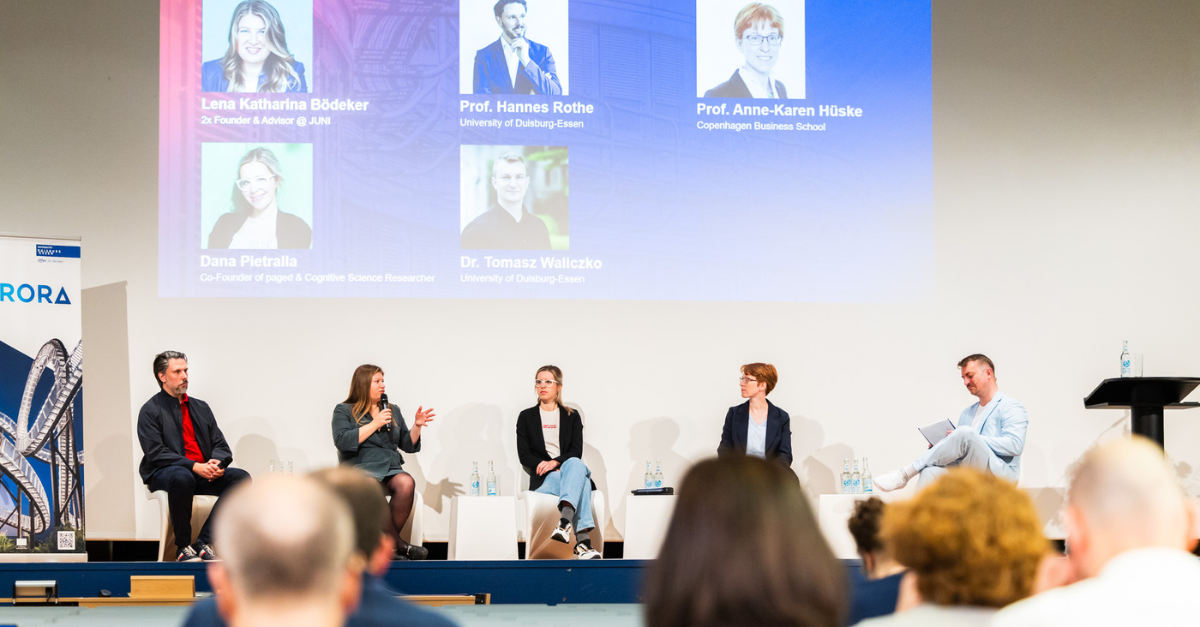
From left to right: Prof. Dr. Hannes Rothe, Lena Katharina Bödeker, Dana Pietralla, Prof. Anne-Karen Hüske, and Dr. Tomasz Waliczko. © Photo credit: eventfotograf.in
At the Aurora Annual Conference 2026, experts from academia, entrepreneurship, and innovation ecosystems, explored how researchers and students can be better supported in turning knowledge into societal and economic impact. The panel featured Prof. Dr. Hannes Rothe, Professor and Chair of Sustainability and Innovation in Digital Ecosystems at the University of Duisburg-Essen (UDE); Lena Katharina Bödeker, twice Founder and Advisor at JUNI; Dana Pietralla, Co-founder of paged and Cognitive Science Researcher; and Prof. Anne-Karen Hüske from Copenhagen Business School (CBS). The plenary session was moderated by Dr. Tomasz Waliczko of UDE.
At The Intersection Of Academia And Entrepreneurship
Prof. Dr. Hannes Rothe highlighted the importance of helping doctoral candidates and postdoctoral researchers translate scientific knowledge into entrepreneurial opportunities. While advocating for stronger entrepreneurial engagement, he also emphasised the continuing importance of curiosity-driven research, noting that today’s fundamental discoveries can become tomorrow’s breakthrough innovations. He further stressed the value of exposing students to entrepreneurship early in their academic journey and proposed more collaborative, interdisciplinary problem-solving initiatives that bring students together to address societal challenges.
Drawing on experiences from Berkeley and New York University, Dana Pietralla discussed the mindset shift required to move from academia into business. She encouraged researchers and students to start by identifying a societal problem before developing solutions, ensuring that innovation serves a broader purpose. According to Pietralla, universities play a crucial role in bringing knowledge into the real world, enabling science and business to work together to address pressing societal challenges. She also highlighted the importance of learning to assess risk and having the courage to pursue entrepreneurial opportunities.
© Photo credit: eventfotograf.in
Addressing Practical Challenges And Stakeholder Management
Lena Katharina Bödeker focused on the practical challenges academics face when becoming entrepreneurs. She noted that researchers often possess strong problem-solving capabilities but may lack the entrepreneurial skills needed to bring ideas to market. Successful innovation, she argued, requires balancing technical feasibility, market viability, and user desirability. Bödeker also emphasised the importance of support structures such as pitch training, mentorship, partnerships, and access to entrepreneurial networks. She further advocated for creating stronger role models and clearer entry points for students interested in entrepreneurship.
Prof. Anne-Karen Hüske highlighted the critical role that stakeholder management plays in the entrepreneurial process. She stressed that founders must balance the interests and perspectives of customers, investors, partners, and society to build sustainable ventures. The discussion also addressed the need for cultural change within universities, encouraging entrepreneurship as a viable pathway alongside traditional academic careers.
© Photo credit: eventfotograf.in
Universities For Entrepreneurial Ecosystems
The panel further explored how universities can strengthen entrepreneurial ecosystems by connecting students and researchers with incubators, startup factories, investors, public funding opportunities, NGOs, and industry partners. Speakers agreed that effective ecosystems require more than financial support; they also need to provide access to networks, expertise, prototyping facilities, infrastructure, guidance, and regulatory support.
Another key topic was inclusivity in entrepreneurship. The discussion highlighted the challenges women and underrepresented groups often face in securing investment and the need for investors to embrace calculated risk-taking to support diverse founders and innovative ideas.
The session concluded with a shared vision: universities have a unique opportunity to empower the next generation of innovators by helping transform research, ideas, and knowledge into solutions that create meaningful societal impact.