News
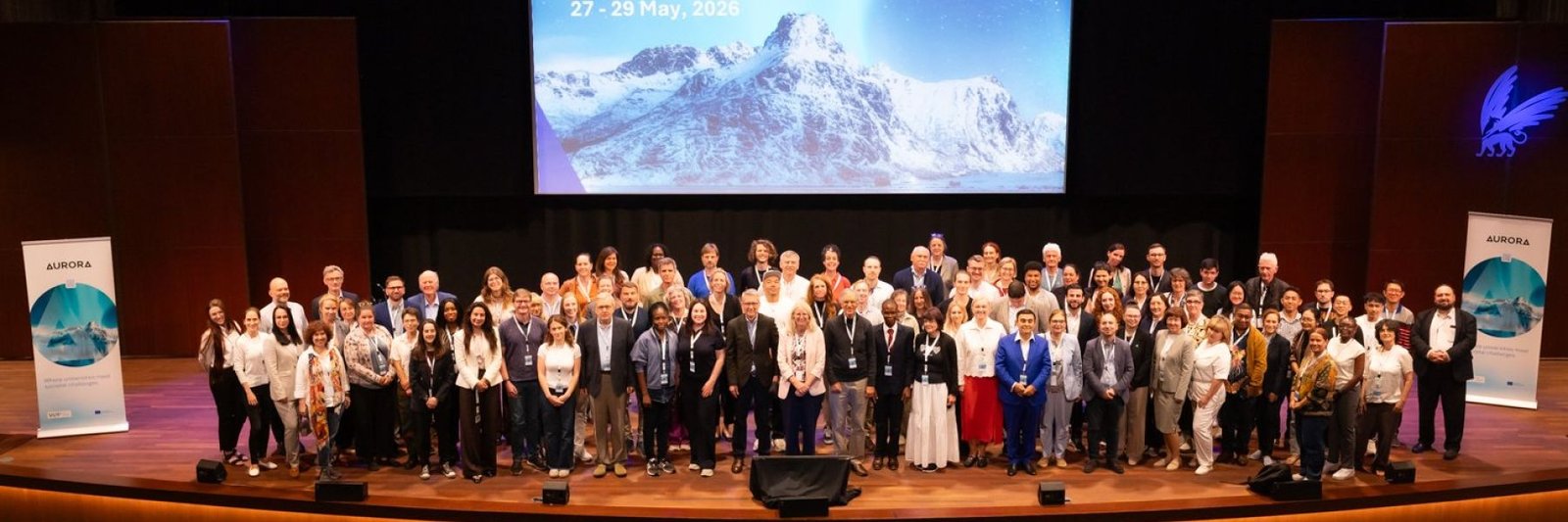
From 27 to 29 May, VU Amsterdam brought together educators, researchers, students, and societal partners from the Aurora network and beyond for three days of discussion on a key challenge in higher education, that is effective approaches to teaching global citizenship.
The Aurora Symposium on Global Citizenship brought together over 160 registered participants from 40+ universities across 23 countries, including 120+ speakers and presenters. Over three days, the programme featured keynote presentations, two high-level panels, eleven workshops, eight paper presentation sessions, four panel discussions, a poster session, and a series of special events. Topics ranged from peace building and societal resilience to community service learning, democratic participation, and innovative pedagogies for global citizenship education. A shared conviction emerged which was that global citizenship is not a subject to add to a syllabus. It is a capacity built through real encounters, responsibility, and reflection.
Day 1: Opening Symposium and Keynotes
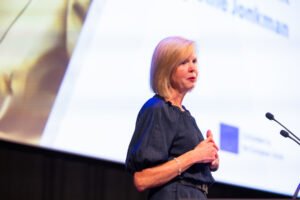
Dr Margrethe Jonkman, President of Vrije Universiteit Amsterdam, emphasised the centrality of global citizenship to VU Amsterdam’s strategy, stating: “Global citizenship is very important in our strategy. And I’m very happy that we are a proud member of Aurora, where like-minded universities want to work together and build the following steps on global citizenship.” — Dr Margrethe Jonkman, Aurora President and President of the Executive Board at Vrije Universiteit Amsterdam.
Ramon Puras, Aurora Secretary General, reinforced this ambition, noting that the Symposium expanded beyond its initial scope to include diverse participants and perspectives: “We not only extended the thematic reach of this symposium. We go beyond Aurora, and we should. That’s what academia should aim for. We remain open and ambitious whilst asking ourselves where our blind spots are” — Ramon Puras, Aurora Secretary General.
The first day started with the question at the heart of the Symposium: Does this work genuinely make a difference? Prof. Robert Bringle answered directly, drawing on education research to argue that service learning transforms students only when it works with communities rather than for them. Dr Augustin Aoudji from the University of Abomey-Calavi in Benin grounded that argument in practice, showing how a university becomes relevant when students co-create solutions in the field rather than observe from outside. The day closed with a presentation on radical uncertainty by Dr Ali Arnaout from Hochschule Wismar in Germany, who explained what it demands of graduates who can no longer rely on a world that behaves predictably.
Day 2: High-level Panel 1 – How Universities Contribute to the Development of Global Citizenship and Community Engagement
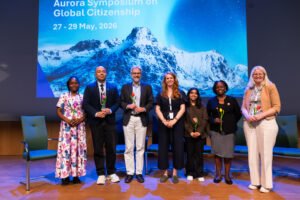
The second day shifted focus from theory to practical university programmes, starting with examples from VU Amsterdam. Govert Buijs introduced the A Broader Mind course, which integrates personal development with academic content. He emphasised that universities play a major role in shaping students over several years and that personal development should be embedded in the curriculum. Dr Frederique Demeijer presented the ICSL course, which extends this approach into the city by having students engage with Amsterdam’s New West neighbourhood to identify community needs. Finance student Zeel Kikani described collaborating with a local Protestant church on a project addressing belonging and the loss of community spaces.
The panel broadened the picture further. Dr Elvire Sossa described a programme where students from Abomey-Calavi lived in rural villages in Benin for six weeks, learning directly from farmers. Dr Joanne Kisaka from Makerere University in Uganda detailed a case where veterinary students and a dairy farmer collaboratively diagnosed a decline in milk production, building trust through repeated visits. The panel discussion addressed challenges such as community fatigue in Amsterdam, where multiple institutions operate in the same areas. The panellists agreed that reciprocity is not merely an ideal but a practical necessity for sustained engagement.
This collaborative spirit continued throughout the programme. Representatives from VU Amsterdam, the University of Abomey-Calavi in Benin, and Makerere University in Uganda provided concrete examples of community-engaged learning and openly discussed challenges, including language barriers, difficulties integrating field experiences into formal curricula, and missed business opportunities due to insufficient seed funding.
Day 3: High Level Panel 2 – The Role of Universities in Peace and Justice
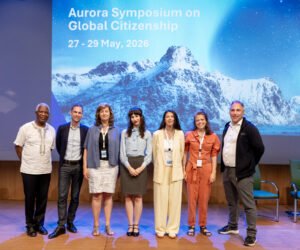
The final day offered a broader perspective. Prof. Jeroen Geurts, Rector of VU Amsterdam, outlined what universities need to be committed to peace, defining peace as ongoing effort rather than just absence of conflict. “Being a peace university doesn’t mean that you’re always peaceful. It means that you never give up, always trying anew to give your students and staff the right tools to reflect on themselves, build connections with others, and jointly take care of the world.” — Prof. Jeroen Geurts, Rector of VU Amsterdam.
Furthermore, Alma Mustafic, a member of the ‘Access to Justice’ research group at University of Applied Sciences Utrecht (HU), contended that universities often shield students from discomfort instead of preparing them for real-world challenges, noting the costs involved. Jan Jorrit Hasselaar from Vrije Universiteit Amsterdam provided a unifying perspective, suggesting that in a world marked by radical uncertainty, universities should cultivate hope that is relational and grounded, recognising that some challenges are ongoing processes rather than problems to solve. Erika Vodvárkova, a master’s student at Sciences Po and recent graduate of Amsterdam University College, urged participants to consider who benefits from global citizenship education and who remains excluded.
The Symposium also included the presentation of awards recognising outstanding contributions to teaching for societal impact across Aurora.
For Aurora’s Teaching for Societal Impact team, led by Prof. Marjolein Zweekhorst and Dr Sarju Sing Rai, the Symposium was both a taking-stock moment and a starting point. The conversations will continue across Aurora’s channels in the weeks ahead.