Aurora Secretary General Ramon Puras, together with Institutional Coordinators Fanney Karlsdóttir (University of Iceland) and Martin Schwell (Université Paris-Est Créteil), represented Aurora at the European Universities Coordinators Meeting held in Brussels. The event brought together close to 200 representatives from European Universities Alliances (EUAs) for a full-day working retreat combining plenary exchanges, thematic breakout sessions and informal networking opportunities.
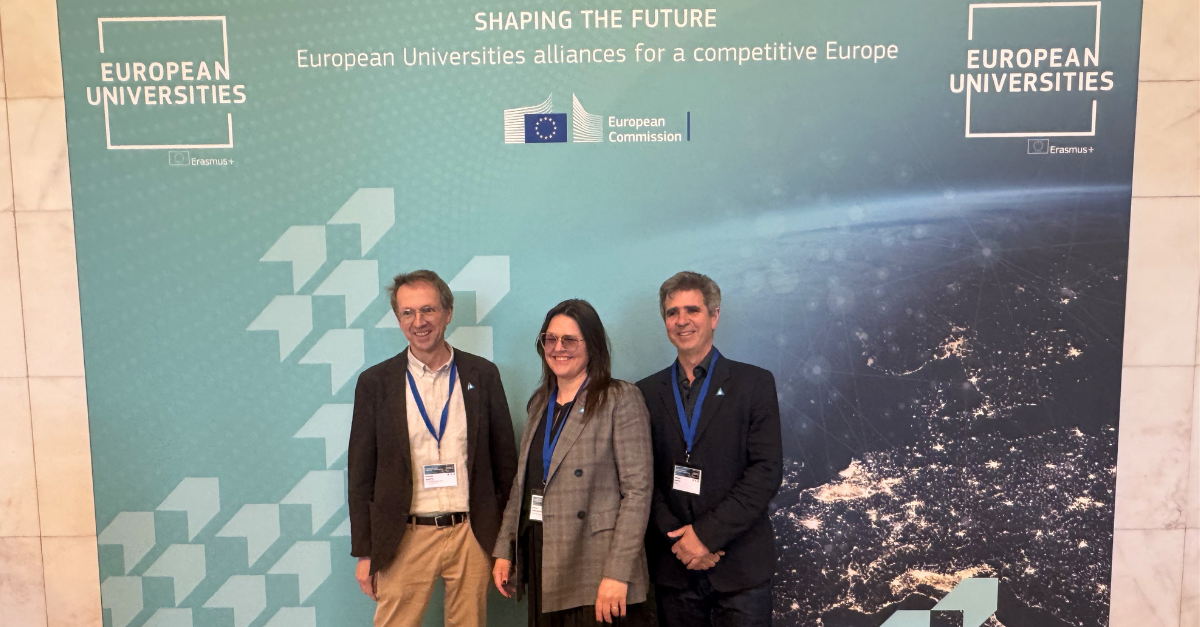 From left to right: Martin Schwell, Fanney Karlsdóttir, and Ramon Puras
Future Erasmus+ Framework, Mobility And International Cooperation
During the day-long European Universities Coordinators Meeting, discussions focused on the evolving role of EUAs within the European Higher Education Area, with particular attention to research cooperation, education strategies and international mobility frameworks.
The first working session explored the future
Erasmus+ funding model in the context of the next programme period, with discussions addressing how to best support
European Universities Alliances in the years ahead.
Participants exchanged views on the conditions for student and staff mobility, as well as on the role of alliances in strengthening international cooperation both within Europe and with partner regions beyond the European Union. The exchanges highlighted the need for stable yet flexible frameworks that can sustain long-term collaboration while responding to evolving institutional needs.
European Competitiveness, Role Of Alliances And Impact Monitoring
The second working session zoomed in on the contribution of European Universities Alliances to EU competitiveness and to the development of the
European Research Area. Exchanges underlined the strategic role of alliances as drivers of cross-border collaboration in education, research and innovation, and as platforms supporting institutional transformation across higher education systems.
The final session addressed performance monitoring and impact reporting. Participants debated how to better capture institutional change and streamline reporting processes, with a shared understanding that effective impact assessment requires combining quantitative indicators with qualitative evidence of transformation.
For Aurora, these discussions also feed into ongoing internal reflections on how to further articulate and monitor the impact of its activities within the broader European framework.