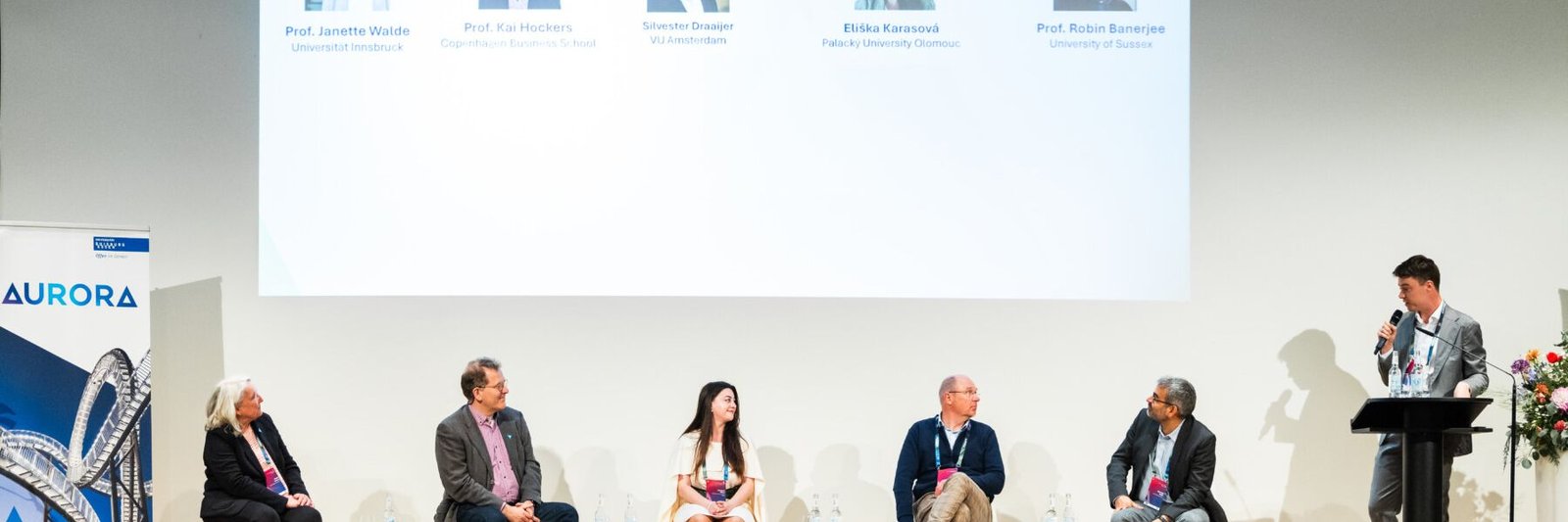
During the Aurora Annual Conference 2026, member universities gathered for a second plenary session, “Aurora 2030 Midway: Achievements, Challenges, and the Road Ahead.” The session marked the midpoint of the Aurora 2030 programme and brought together reflections on progress, upcoming challenges, and the alliance’s ambitions for 2030. Alexander Lindemans, Aurora 2030 Programme Manager at the Aurora Central Office, and Fanney Karlsdottir, Aurora Institutional Coordinator at the University of Iceland, moderated the session.
A tough but encouraging midterm review
Secretary General Ramon Puras opened the session by reflecting on Aurora’s recent midterm review, describing it as a demanding assessment from the European Commission’s review committee. However, he said a recent conversation with Aurora’s project officer in Brussels confirmed the alliance is performing well overall, even though several areas still need attention.
Dr Puras pointed to strengths in challenge-based research, education, community service learning, and student engagement. He also stressed the need for stronger commitment to the virtual campus, clearer prioritisation of the educational portfolio, and more sustainable integration within partner institutions.
Alexander Lindemans followed with a summary of the midterm assessment. He said Aurora is still consolidating as it moves from a pilot initiative toward a fuller European university ecosystem. Reviewers highlighted challenge-based, transdisciplinary education, strong student engagement, and Aurora’s service-based learning approach, including community courses, social entrepreneurship, and the LOUIS competence framework, as key strengths. Future priorities include expanding flexible, stackable educational offerings, building capacity in central and eastern Europe, and further developing the virtual campus. Alexander stressed that Aurora must show impact, not just progress, in its final evaluation.
Key values identified by Aurora partners
An interactive Mentimeter segment invited the audience to reflect on Aurora’s value, both for their institutions and personally. Responses pointed repeatedly to collaboration, networking, funding, interdisciplinarity, trust, and student engagement as the value Aurora brings to member institutions. On a personal level, participants highlighted community, inspiration, engagement, and the friendships built through the network.
Panel members reflected on why these results resonated. Prof. Janette Walde from the University of Innsbruck said the overlap between institutional and personal value matters because it makes engagement easier to sustain. She pointed to internationalisation at home as particularly important for students who cannot study abroad for a full semester.
Eliška Karasová, Vice President of the Student Council, said it was encouraging to see how differently people described Aurora’s value, adding that sharing those varied perspectives helps partners build something bigger together.
Kai Hockerts, professor at Copenhagen Business School, pointed to interdisciplinarity as the theme that resonated most with him, recalling a hackathon in Naples where students from different disciplines and institutions worked together for the first time. He described watching business and sociology students challenge each other’s assumptions as capturing what he called the Aurora spirit.
Future educational priorities for Aurora
Participants were also asked which educational focus areas and pedagogical tools Aurora should prioritise. Sustainability and climate change drew the strongest support, alongside growing interest in the newly added peace education hub. Community service learning and the LOUIS framework also received positive feedback, echoing comments from the midterm review. Silvester Draaijer, co-lead of Work Package 2 and leader of the Digital Society and Global Citizenship Hub, offered a personal take on the results. His own hub ranked lower in the audience poll, yet he argued that Aurora should narrow its thematic focus and prioritise cultural diversity and identity, given its role as a European university alliance.
Kai Hockerts argued that having the right priorities matters less than having people willing to lead them. Drawing on past task teams that lost momentum without a clear owner, he said committed leadership is what ultimately determines whether a hub or initiative succeeds.
Looking toward 2030
Asked what they hoped Aurora’s main success would look like by 2030, participants pointed to joint degree programmes, stronger student representation, a functioning virtual campus, and greater visibility and global impact.
Prof Robin Banerjee closed the discussion by drawing a distinction between the practical work of delivering joint degrees and a virtual campus, and the bigger picture of what that work is ultimately for. He suggested Aurora’s deeper ambition should be fostering community cohesion, bringing people together across the divisions and polarisation increasingly visible across society.
Silvester Draaijer closed on a similar note, describing the coming years as a balancing act between pragmatism and ambition. He pointed to the value of cutting through institutional bureaucracy where needed, while keeping sight of Aurora’s longer-term goals for 2030 and beyond. Watch the video for the full plenary: