News
The Erosion Of Trust In Academia? Five Voices From Across Europe Respond
The session was moderated by Vice Dean for Digitalization at the Faculty of Social Sciences and political scientist at the the University of Duisburg-Essen, Julia Schwanholz, whose own research focuses on democracy under pressure. She opened by noting that declining trust in democratic institutions and declining trust in academia are closely linked matters, before handing the floor to a panel of five.
Data Speaks Volumes
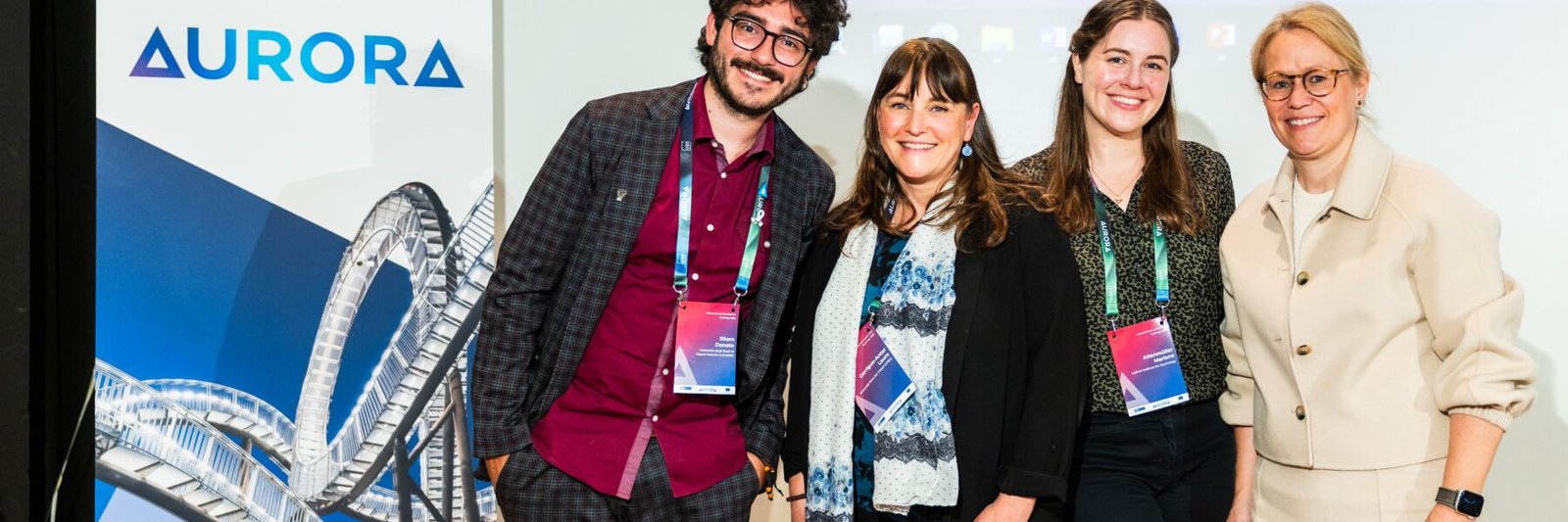
The panel’s first speaker, Prof. Marlene Altenmüller, a professor specialising in science reception at the Leibniz Institute for Psychology, addressed a common misconception. Drawing on a major international study published in Nature Human Behaviour, led by Viktoria Cologna and Niels Mede and involving over 240 researchers from 68 countries and more than 70,000 participants, Prof Altenmüller clarified that there is no empirical evidence of a global trust crisis in science. Trust remains reasonably high and stable worldwide, she argued. In Germany, trust even increased during the pandemic instead of declining.
However, she emphasised that this general trust in science as a system differs from trust in specific findings, where isolated incidents can still spark scepticism. She concluded that while the foundation of trust is strong, it cannot be assumed to be unbreakable.
Institutional responses, from Paris to Naples
Prof. Laure Garrigue-Antar, Vice-President for Science and Society at Université Paris-Est Créteil, explained how a “national science and society” label awarded to her university as a response to post-pandemic mistrust became a catalyst for a more coherent institutional policy. The university has entered a new phase with the engaged science programme, aiming to strengthen links between the university and surrounding communities through open science and citizen engagement. Within Aurora, this initiative directly connects to work package 5 on Research and Innovation and work package 10 on Dissemination and Impact, including reform of research assessment along the lines of the Coara principles and continued investment in open science infrastructure.
Elsewhere on the panel, Dr Donato Sitaro, a Postdoctoral Research Fellow in Medieval History from the University of Naples Federico II, focused on institutional reform. He argued that universities have surrendered social media to bots, trolls, and AI-generated content. Institutions should create a deliberate, expert-led presence, akin to fact-checking organizations combating hate speech, he said. He then turned to research culture itself. He drew on his own experience moving between Italy and the UK during his PhD. Italian researchers are often reluctant to share work openly, he noted. The fear, as he put it, is that “someone can steal it.” He traced this mindset back to publish-or-perish pressure. Institutions need a “Copernican revolution” in how they treat research, he argued. This means shifting the centre of gravity from individual ownership to community benefit. He concluded that Aurora, as a network built on shared values, is well placed to support that shift.
Diplomacy, communication and scholars at risk
Representing the European Commission’s DG Research and Innovation, Dr Jan Marco Müller works on science diplomacy. He described the current environment as a perfect storm of geopolitical realignment, a technology race between nations and mounting global challenges such as climate change, all of which erode trust between countries as much as within them. He previewed a new EU framework for science diplomacy and noted that strengthening trust in science is one of its explicit objectives.
Dr Catherine Letcher Lazo, department head of the DAAD’s Centre for International Academic Cooperation, focused on the DAAD’s three pillars for defending the value of science in society. The first pillar is sustaining long-standing academic partnerships in politically sensitive regions. DAAD does this through a network of more than 70 country offices. The second is investing in science communication training and formats. The third is protecting scholars at risk. This happens through programmes that support researchers who face restrictive conditions or must leave their countries. She described trust, in this context, as an “invisible infrastructure” that underpins international cooperation.
Active floor discussion
The floor discussion, which lasted about 90 minutes and was open to audience questions, repeatedly returned to a few key themes. Several speakers gently pushed back on the idea that scientists alone should build public dialogue. This work requires dedicated funding and dedicated roles, they argued, not an add-on to an already overstretched research career. Social media emerged repeatedly as what one panellist called a genuine battleground. Expert presence there is thin, he said, and AI-generated content increasingly shapes the conversation. More than one contributor turned the question back on academia itself. Have publish-or-perish incentives made researchers more competitive with each other, they asked. Are researchers now less oriented toward the public good they are meant to serve?
Ultimately, the final word went to Jan Marco Muller, who framed trust as “a blend of a number of issues,” resting on integrity, transparency and personal relations. The session concluded on that note of shared responsibility between science and policy.
Watch the full plenary session below for the complete panel discussion and audience Q&A.